Open-Source AI Models Have Caught Up — Here's What That Means
By LumaVista Team


Two years ago, anyone who said “we’ll use open-source models” was accepting a quality tradeoff. You’d get privacy and control, sure — but you’d also get noticeably worse answers. The frontier belonged to OpenAI and Anthropic, and everyone else was playing catch-up.
That’s no longer true.
In the first quarter of 2026, at least five independent model families are competing at or near the frontier of AI capability. Some are open-weight. Some are fully open-source. And several of them didn’t come from Silicon Valley. The gap between closed and open models hasn’t just narrowed — for most practical tasks, it’s closed.
The convergence: five families at the frontier
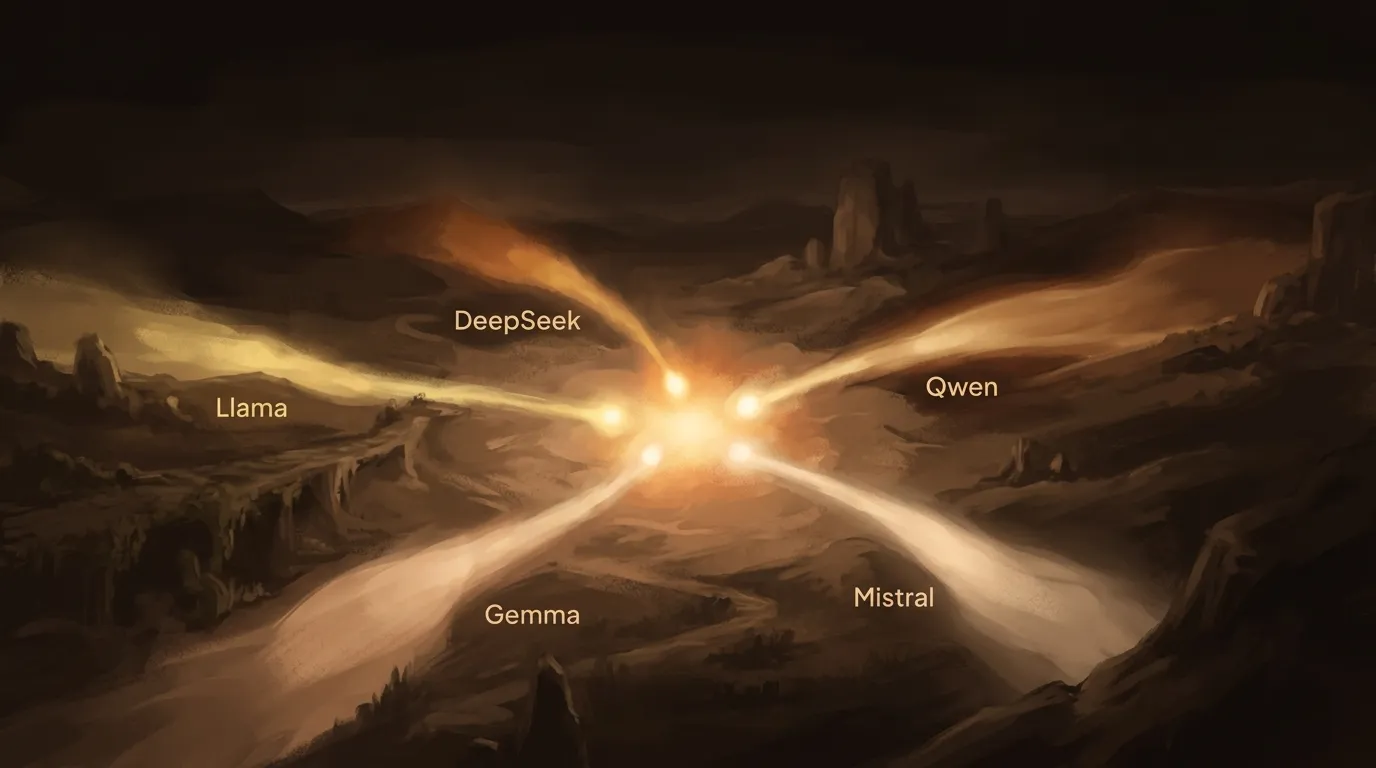
Here’s what the landscape looks like right now:
Meta’s Llama 4 arrived in April 2025 with Maverick and Scout variants. Maverick is a mixture-of-experts model with 128 experts that’s competitive with GPT-4o across a wide range of benchmarks. Scout handles a ten-million-token context window — useful if you need to process an entire codebase or a year’s worth of legal filings in a single pass. Both are open-weight under Meta’s Llama Community License.
DeepSeek V3 and R1 came out of a Chinese lab and caught the industry off guard. DeepSeek-R1 matches OpenAI’s o1 on mathematical reasoning benchmarks — scoring 97.3% on MATH-500 compared to o1’s 96.4% — and they published their training methodology in detail. V3 is a 671-billion-parameter mixture-of-experts model that rivals GPT-4o across general tasks — and since the March 2025 V3-0324 update its weights ship under an MIT license, meaning anyone can use it for anything.
Qwen 2.5 from Alibaba’s research team is another strong contender. The 72B parameter version competes with models several times its size on coding and reasoning tasks. Most sizes are Apache 2.0 licensed — the 3B and 72B variants ship under Alibaba’s own Qwen license — and the family has become a popular base for fine-tuning in the European research community.
Mistral Large and Medium come from Mistral AI, a Paris-based company. Their models consistently rank near the top of coding and reasoning benchmarks on LMSYS Chatbot Arena, and they’ve built a reputation for producing efficient models that punch above their weight class. Being EU-headquartered matters — more on that shortly.
Google’s Gemma 2 rounds out the picture as an open-weight offering from a hyperscaler. The 27B version delivers surprisingly strong performance for its size, and the Gemma Terms of Use — which allow commercial and research use — mean it shows up everywhere from mobile apps to research labs.
That’s five model families from three different countries, and every one of them is available for you to download, inspect, and run on your own hardware. Two years ago, the open-source frontier was GPT-3.5-level at best. Today, it’s GPT-4-level and climbing.
Five independent model families, three countries, all downloadable. The closed-model monopoly on frontier AI capability is over.
What benchmarks actually mean in practice
Let’s be honest about benchmarks: they’re useful but imperfect. When someone says “DeepSeek-R1 matches o1 on MATH-500,” that tells you something real about mathematical reasoning ability. But it doesn’t tell you how the model handles your specific compliance workflow or your legal research queries.
Here’s a more practical way to think about it. Two years ago, the gap between open and closed models was obvious in daily use. You’d ask an open model to analyze a contract and get a vaguely relevant summary. You’d ask GPT-4 the same question and get a structured analysis with specific clause references. That qualitative difference has largely disappeared.
Today’s open models handle complex reasoning, nuanced writing, multi-step analysis, and domain-specific tasks at a level that’s genuinely hard to distinguish from their closed counterparts in blind tests. They still have individual strengths and weaknesses — Llama 4 is particularly strong at multilingual tasks, DeepSeek excels at math and code, Qwen punches above its weight in structured reasoning — but none of them feel like a “budget option” anymore.
The remaining differences are at the edges. For the absolute hardest reasoning problems, the latest closed models from OpenAI and Anthropic still have a slight edge. But “slight edge on the hardest 5% of tasks” is a very different proposition from “noticeably worse at everything,” which is where we were in 2024.
Why this happened so fast
Three things converged to close the gap:
Training recipes became public knowledge. When Meta released the Llama training methodology, and DeepSeek published detailed papers on their approach, it became possible for other teams to replicate frontier-level training without starting from scratch. The secret sauce turned out to be more recipe than secret.
Hardware got cheaper and more available. The cost of training a frontier model has dropped dramatically. DeepSeek reportedly trained V3 for roughly €5.2 million — a fraction of GPT-4’s estimated €92 million+ training cost — partly through architectural innovations like multi-head latent attention and partly because GPU compute continues to get cheaper per FLOP. You don’t need Google’s budget to train a world-class model anymore.
Open-weight begets open-weight. Once several strong open models existed, they became foundations for further research. Teams could fine-tune, distill, and improve upon existing open models instead of training from zero. This created a flywheel effect: every good open release made the next one easier to build.
The result is a competitive landscape that looks nothing like 2024. Back then, OpenAI had a clear lead, Anthropic was a strong second, and everyone else was somewhere between “interesting research project” and “good enough for simple tasks.” Now there’s genuine multipolarity — multiple capable models from multiple organizations in multiple countries.
DeepSeek trained a frontier model for €5.2 million. Two years ago that would have cost €92 million or more. The economics of AI shifted faster than anyone predicted.
The sovereignty implication
Here’s where this gets interesting for European organizations. The biggest objection to sovereign AI infrastructure has always been: “Sure, but the best models are American. If we can’t use GPT-4 or Claude, we’re accepting worse tools.”
That objection just evaporated.
If Llama 4 Maverick matches GPT-4o on your tasks, and you can run it on EU-sovereign infrastructure, the quality tradeoff argument is gone. You’re not sacrificing capability for sovereignty — you’re getting both.
This matters enormously for organizations bound by data sovereignty requirements. As we’ve covered, there’s a critical difference between data that’s geographically in Europe and data that’s legally in Europe. Using a US-hosted API — even with an “EU region” setting — still means your queries are accessible under the CLOUD Act. Running an open-weight model on EU infrastructure severs that legal dependency entirely.
LumaVista exists precisely because this convergence was coming. Running multiple frontier-quality open models on dedicated EU GPU servers means no US company anywhere in the data path. Your research queries stay under European jurisdiction — not because of a contractual promise, but because the infrastructure is architected that way from the ground up.

The origin question: let’s talk about it honestly
Some of the best open models right now — DeepSeek and Qwen — come from Chinese labs. That raises legitimate questions for organizations with security requirements, and it’s worth addressing directly rather than pretending it’s not a factor.
Here’s the thing: open-weight models are inspectable. The weights are published. The training methodology is documented. Security researchers can (and do) examine them for backdoors, hidden behaviors, and training data contamination. This is fundamentally different from using a closed API where you’re trusting the provider entirely.
That said, “open weights” doesn’t mean “no concerns.” Some organizations have procurement policies that restrict software from certain jurisdictions. Others face regulatory requirements about supply chain provenance. These are real constraints, and they’re worth taking seriously.
The practical answer for most European organizations is straightforward: use the open models that fit your risk profile. If Chinese-origin models aren’t acceptable for your use case, Llama 4 (American-origin, open-weight), Mistral (French-origin), and Gemma (American-origin) give you frontier-quality alternatives. The point isn’t that you must use every open model — it’s that you have choices. Multiple, high-quality, independently developed choices.
Open-weight models are inspectable in a way closed APIs never can be. The weights are published, the training is documented, and security researchers can audit for backdoors.
Why Mistral is worth watching for EU organizations
Mistral AI deserves a specific mention because of where it sits in this landscape. It’s the only frontier-class model developer headquartered in the EU. That’s not just a nice talking point — it has practical implications.
When your model provider is EU-incorporated with no US parent company, the entire relationship — from licensing to support to security response — operates under EU jurisdiction. There’s no CLOUD Act pathway. There’s no ambiguity about which legal framework governs your data.
Mistral’s models are also designed with efficiency in mind, which matters for organizations running inference on their own hardware. Their mixture-of-experts approach means you get strong performance without needing the absolute largest GPU clusters. For an EU organization building sovereign AI infrastructure, Mistral is the most natural fit — frontier quality, EU jurisdiction, efficient architecture.

The forward outlook
The convergence isn’t stopping. If anything, the pace of open-model improvement is accelerating. Every month brings new releases, new training innovations, and new demonstrations of open models matching or exceeding closed ones on specific tasks.
Here’s what to expect over the next twelve months:
More mixture-of-experts architectures. Both Llama 4 and DeepSeek V3 use MoE designs, where only a subset of the model’s parameters activate for each query. This makes models cheaper to run without sacrificing quality. Expect this to become the default architecture for large open models.
Longer context windows becoming standard. Llama 4 Scout already handles ten million tokens. Long-context capability used to be a closed-model advantage — that’s gone. If you need to process entire document collections in a single pass, open models can do it.
Specialized fine-tunes proliferating. Open weights enable domain-specific adaptation. We’re already seeing medical, legal, and financial fine-tunes of base models that outperform generalist closed models on domain-specific tasks. This is the practical proof behind the argument against chasing one god-model — specialists are already good enough. This trend will accelerate.
Training costs continuing to fall. The efficiency innovations coming out of DeepSeek and others are being adopted across the field. Lower training costs mean more teams can train frontier models, which means more competition, which means faster improvement.
The practical implication: if your organization hasn’t evaluated open models recently, your information is out of date. The models available today aren’t the same ones you looked at in 2024. And the ones available in six months will be better still.
What to do now
-
Benchmark current open models against your actual workloads. Don’t rely on published benchmarks alone. Take your real use cases — the queries you actually send to ChatGPT or Claude — and run them through Llama 4 Maverick, DeepSeek V3, and Mistral Large. Compare the outputs yourself.
-
Reassess your “closed models are better” assumption. If you made an infrastructure decision in 2024 based on model quality, that decision needs revisiting. The landscape has shifted fundamentally.
-
Map your sovereignty exposure. If you’re using US-hosted AI APIs for sensitive work, you have a CLOUD Act exposure that open models on EU infrastructure would eliminate. Quantify it.
-
Start with your highest-risk use cases. Legal research, financial analysis, medical data, competitive intelligence — these are the workloads where sovereignty matters most and where open models now offer a genuine alternative.
-
Evaluate EU-sovereign inference platforms. Running your own models requires GPU infrastructure, but you don’t have to build it from scratch. Providers like LumaVista offer managed inference on EU-sovereign hardware — frontier open models, no US jurisdiction in the chain.
-
Build model flexibility into your architecture. The days of being locked into a single AI provider are ending. Design your AI workflows to be model-agnostic so you can swap in better open models as they appear — because they will, and quickly.
-
Prepare for the EU AI Act. Most remaining obligations apply from August 2, 2026, and the high-risk rules follow on December 2, 2027 after the May 2026 Digital Omnibus deferral. Organizations using AI for high-risk applications will need to document their model supply chain. Open-weight models on sovereign infrastructure make that documentation straightforward. Closed APIs through US providers? That’s a harder compliance story to tell.
The quality gap between open and closed AI models is effectively gone. The sovereignty gap between EU-hosted and US-hosted AI infrastructure remains wide open. For European organizations, that combination points in one clear direction: open models, sovereign infrastructure, no compromises on either front.